
The Schematic: The Manual, Rewritten

Every maintainer is trained from the same source of truth: the technical order. It’s authoritative and essential, but that knowledge still lives flat on a page or a screen.
This month, the Air Force reassigned its combat air forces Formal Training Units from AETC to ACC. The reorg lets AETC sharpen its focus on foundational skills while ACC takes on advanced tactics. Behind it is a more fundamental question: how do we shorten the distance between what a trainee studies and what they can actually do?
That pressure is growing quickly. Across the military, the bottleneck is no longer access to information. It’s the speed at which training pipelines can turn technical knowledge into operational capability.
In the News
The maintenance training pipeline is structurally short. The U.S. aircraft mechanic shortfall sits at roughly 24,000 unfilled positions and growing, with military training organizations outputting roughly 30% below demand.
Units across the field are already experimenting with ways to close that gap. In April, the 1st Armored Division at Fort Bliss put AR-enabled maintenance tools into the hands of soldiers and watched maintenance tasks that used to take an hour collapse to 15 to 20 minutes.
The signal is clear: the distance between training and performance is compressible. The harder question is where that distance actually shows up in practice.
From the Field
At the installation level, that question has a concrete answer.
The technical order doesn't lie. But it doesn't move, either. Maintainers tell us the same thing over and over: they can pass every written test and still freeze in front of the real system. The documentation covers the procedure. It doesn’t cover orientation: where things actually are, how they relate to each other, what it looks like when it's right and when it isn't.
That's the gap. And it shows up every time a new maintainer walks up to an unfamiliar asset for the first time.
What We're Building: The AI-Enabled 3D Instruction Manual
We keep hearing the same thing from maintainers and instructors: documentation isn't the problem, translation is.
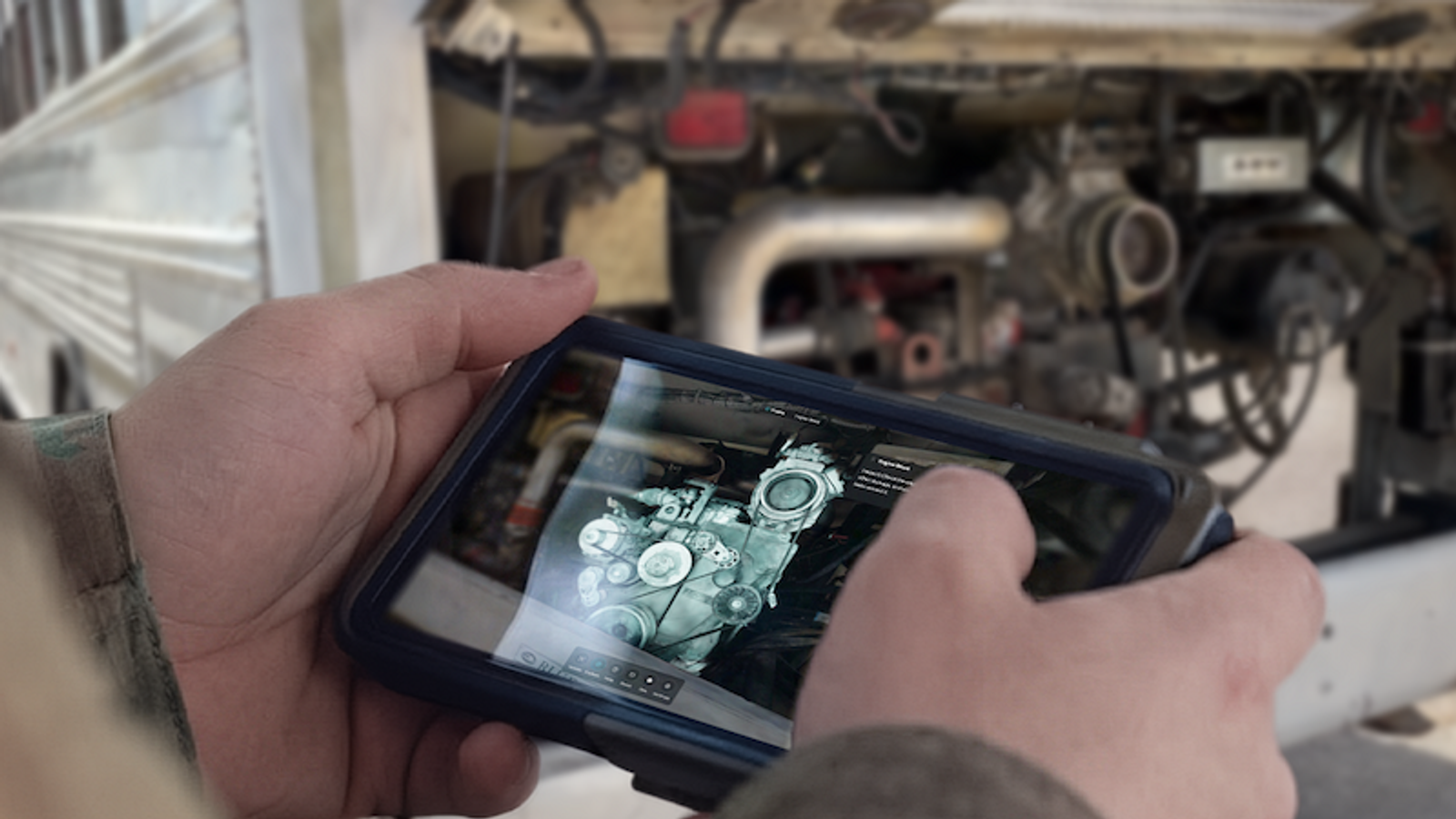
Imagine opening your TO and seeing not just the procedure, but the machine itself. Photorealistic. Explorable. The exact equipment you'll work on tomorrow.
Step through the procedure and the model moves with you. Components animate, move, and orient you to exactly what you're looking at before you've touched a single piece of the equipment.
The manual you already trust, rendered in three dimensions, with an instructor that doesn't run out of time.
Why It Matters
The shortage won't be solved by recruiting harder. It's a throughput problem, and the acquisition environment is finally catching up to that reality.
In January, the Department of War issued a department-wide AI strategy that explicitly named speed of deployment as a strategic priority. Combined with ongoing field experimentation across the services, the institutional question has shifted from "is this allowed?" to "how fast can we field it?"
3D and AI on top of trusted documentation is one of the lowest-friction places to start. The reference material is already there. The acquisition language is already there. The barrier isn't resources or permission. It's format.
In recent defense deployments, our AI-Enabled 3D Instruction Manual has cut training time by up to 75% and instructor workload by up to 40%. Students saved an average of ~7 hours of study per certification. Instructors saved ~5 hours per trainee. Equivalent to hundreds of dollars in recovered labor per trainee before accounting for readiness gains.
The technical order isn't getting replaced. It's getting a second format. The same authoritative document, rendered into something a trainee can step inside before they touch the actual system.
Closing Thought
The question for every organization managing a training pipeline isn't whether AI-enabled tools belong in it. The question is how quickly they can operationalize them.
That's the manual, rewritten.
— The Schemata Team. Turning the physical world into knowledge.