
The Schematic: The Next Frontier is Physical

In 2026, the most consequential race in AI isn't over who can write the best essay. It's over something harder: teaching machines to understand the physical world.
Researchers call these systems world models. AI that can reconstruct, simulate, and reason about real environments. Not just process text or retrieve information, but understand space. What's in it, how it's structured, and how the parts of a system relate to each other.
In the News
The shift toward world models keeps accelerating. In July, TIME reported that the industry's top AI labs are converging on a single idea: models that learn how physical systems actually behave, not just what people write about them. It's the broader move toward systems that learn directly from the physical world, not just from descriptions of it.
The defense sector is already grappling with what that means for training specifically. At a major industry symposium this summer, panelists spent their session on a hard question: what does it actually take to build a digital twin that understands the equipment it represents, not just recreates its shape? Their consensus: the hard part isn't the AI; it's building something that actually understands the equipment underneath it, not just represents it.
What We're Building: AI that Understands Your World
At Schemata, we view this as more than a research trend. It is the foundation for building AI that understands equipment, documentation, and operational environments the way maintainers and operators do.
In June, we released Exploded Views and Animated Procedures. Users can now break a system into its individual components and explore how parts fit together before ever touching the equipment itself. Animated Procedures guide learners through tasks step by step, highlighting relevant components as they progress.
In July, we took the next step. Schemata's AI can now analyze a learner's active 3D environment and answer questions based on the specific equipment and components in view. Rather than responding only to a written prompt, it can identify relevant objects in the scene, reason across multiple components at once, and explain how they relate to one another in context.
The same capability extends beyond training environments. Earlier this summer, we published a closer look at how this context-aware assistance supports maintainers in the field, answering plain-language questions while citing the exact procedures and technical documentation used to generate each response.
The common thread across these updates is simple: AI that understands the user's situation without requiring them to describe every detail first.
From the Field
The need for this kind of understanding became clear in conversations with instructors earlier this year.
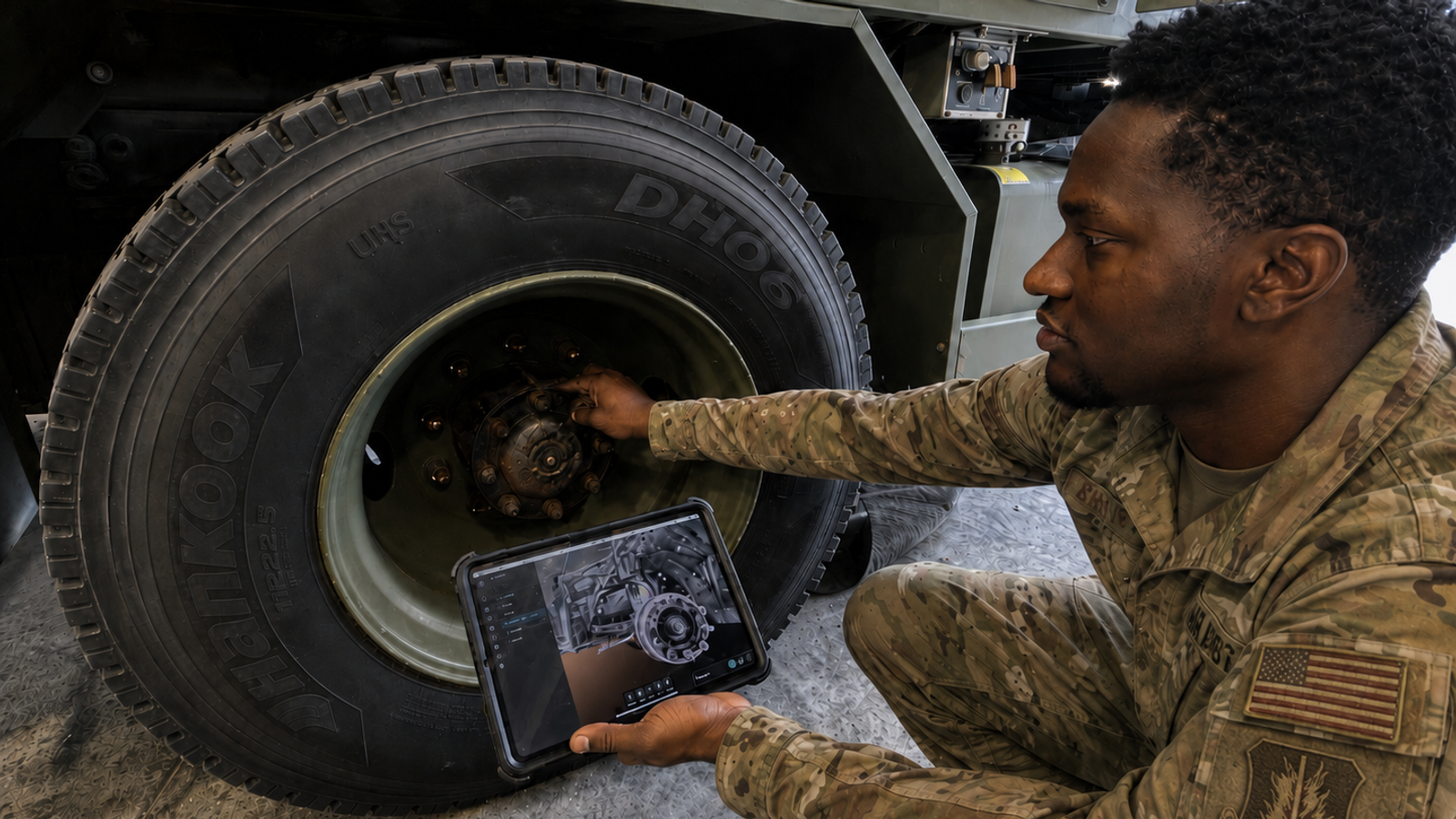
During a visit to an Air Force installation, one theme came up repeatedly: traditional training systems struggled to match how today's learners actually want to learn.
"The new generation of Airmen learn this way," one instructor told us. "We want to be able to bring this to the field, bring it to the home, bring it to remote environments."
Traditional hardware trainers can place a trainee in front of a vehicle. They cannot travel home with them, run on a phone before an inspection, or provide practice opportunities outside a dedicated facility.
The shift toward portable, interactive training is already happening. The question is no longer whether training can leave the classroom. It's what becomes possible once it does.
Why It Matters
The first phase of this transformation was about format.
Trusted documentation was converted into interactive, spatial, and AI-assisted experiences. The results validated the approach: up to a 75% reduction in training time and a 40% reduction in instructor workload.
The next phase is about understanding.
Not simply retrieving the right document when asked, but understanding how a system is organized. Knowing which components are connected, what a failure in one subsystem implies for another, and how a procedure relates to the equipment directly in front of the maintainer.
For the organizations we work with, the challenge was never a lack of information. The challenge was turning information into understanding quickly enough to matter, on the exact equipment someone would encounter in the field.
The documentation problem was largely a problem of format.
What comes next is a problem of comprehension.
Closing Thought
The technologies being described as world models are pushing AI toward a deeper understanding of physical systems and environments.
The question now is not whether that capability is coming, but how quickly it can be applied to the equipment, infrastructure, and operational environments where people need it most.
The first generation of AI read about the world. The next generation understands it.
— The Schemata Team. Turning the physical world into knowledge.
Curious to see what we're building? Schedule a demo with our team.